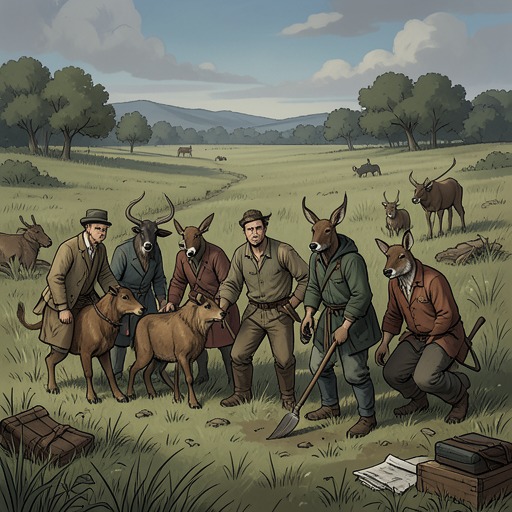
For the good of the species
The Selfish Gene“For the good of the species” is an expression for the idea that animals evolve to restrain their own interests for the survival of their species or group. The book treats it as a powerful intuition rather than a sound general explanation of altruism: moral admiration for self-sacrifice does not show that group benefit is what natural selection selects for.
From reproduction to a theory of altruism
The reasoning begins with a familiar observation: much of animal life is devoted to reproduction, and conspicuous acts of self-sacrifice often occur when parents care for their young. Because reproduction perpetuates a species, it is easy to stretch that description into a claim about purpose: reproduction exists “for” the species, and animals therefore behave to preserve it. The book identifies this as a false step. A consequence of reproduction has been mistaken for the evolutionary cause of behavior.
The mistaken inference also draws strength from how natural selection is described. If the competitors in the struggle for existence are taken to be species or groups, then an individual can appear to be a pawn whose sacrifice serves the larger unit. A group of self-sacrificing members might seem less likely to become extinct than a rival group whose members put themselves first. This is the group-selection argument: groups prosper because their members act for the group’s good.
The challenge from individual and gene selection
The book’s counterargument focuses on what happens within a supposedly altruistic group. If even one member refuses to make sacrifices and takes advantage of the others, that individual is more likely to survive and reproduce. If selfish traits are inherited, they can spread over generations until the group is no longer distinct from a selfish one. Nor is a group protected merely by beginning with altruistic members: selfish individuals might migrate in from neighboring groups and reproduce there.
Groups can indeed go extinct, and the behavior of their members can affect that outcome. But extinction is slow beside competition among individuals. While a group declines, individuals who benefit at the expense of altruists may prosper in the short term. The argument therefore challenges the assumption that an eventual group-level consequence is enough to explain the selection of self-sacrificing behavior. In the book’s preferred framing, the relevant unit is the gene: successful genes may sometimes favor limited altruism among animals, but that is different from selection acting for the welfare of a species as a whole.
This distinction does not deny that behavior can be inherited or shaped by genes. Rather, genes influence behavior indirectly, through development and the nervous systems of the animals that carry them; a “gene for” a behavior is a convenient way of describing a genetic influence, not a claim that one gene single-handedly produces a complex action. The expression “for the good of the species” can obscure this distinction by turning an apparent benefit into an assumed purpose.
Why the expression persists
The group-selection idea has an intuitive and educational life beyond its standing among biologists. The book notes that professional biologists familiar with evolutionary theory give it little support, yet successive zoology students are surprised to learn that it is not orthodox. A British advanced-level biology teachers’ guide even described animal behavior as including individual suicide to ensure the species’ survival. The example shows how readily the expression’s logic can pass as settled explanation when its controversial assumptions go unexamined.
The book also points to Konrad Lorenz’s account of aggressive behavior as serving species preservation by ensuring that only the fittest breed. It criticizes that reasoning as circular: the supposed function is inferred from an outcome that is itself treated as proof of the function. Likewise, on a BBC program about Australian spiders, an expert suggested that the many young spiders eaten by other species might exist so that the few survivors could preserve the species. These examples illustrate the expression’s rhetorical reach, not evidence that group benefit caused the behavior.
Moral appeal and its limits
The expression resonates because people often admire those who put others first, even when they behave selfishly themselves. But “others” can mean very different groups. Altruism within a group can accompany selfishness between groups: trade union solidarity is one example, while national appeals may ask individuals to die for their country and to kill people identified only as members of another nation. The appeal to the group’s good does not, by itself, establish universal concern.
Broadening the circle from nation to humanity does not eliminate the tension. The book observes that people who champion fellow feeling for the whole human species may still object when concern extends to other species, such as whales. The expression therefore carries a moral question about who counts as the group, while its evolutionary use makes a separate explanatory claim. The book insists that the two should not be confused: describing how behavior evolved does not prescribe how people ought to behave. Indeed, its warning is that biological nature offers little help to those seeking a generous society, so human beings must teach generosity rather than treat it as an automatic consequence of evolution.